ADHD vs Learning Disability: What’s the Difference?

Child with ADHD and Learning Disabilities
The ADHD-Learning Disability Link
ADHD (Attention-Deficit/Hyperactivity Disorder) is not a learning disability in itself—but it affects the brain’s executive functions, such as:
Attention and focus
Working memory
Task initiation and completion
Organization
These skills are the foundation for learning. So when ADHD is present, it can mask or amplify the symptoms of a learning disability like:
Dyslexia (reading challenges)
Dysgraphia (writing difficulties)
Dyscalculia (math struggles)
Auditory Processing Disorder
In fact, up to 50% of children with ADHD also have a specific learning disability. That’s why it’s so important to consider both when a child is falling behind in school.
How the Two Conditions Interact
Here’s how ADHD and learning disabilities can look when they coexist:
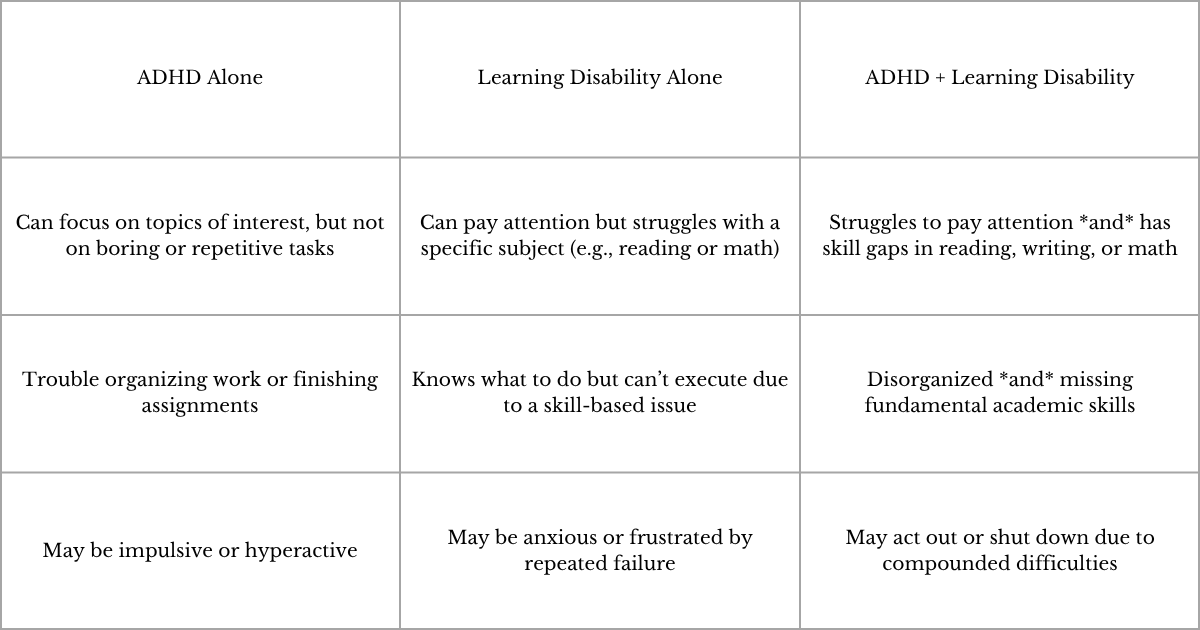
Chart comparing ADHD and Learning Disabilities
This overlap can make diagnosis tricky—kids are often misidentified as “lazy” or “unmotivated,” when in fact, they’re working much harder than peers just to keep up. ADHD Life Medical Associates can help you with this.
How to Know If Your Child Has Both
Cognitive testing can be one of the most powerful tools for understanding how your child thinks, learns, and processes information—not just identifying challenges, but revealing strengths.
At ADHD Life Medical Associates, we utilize MindPrint Learning, an advanced, research-based cognitive assessment developed through work at the University of Pennsylvania. This tool provides a comprehensive snapshot of your child’s learning profile in a way that is both accessible and highly actionable.
MindPrint evaluates key cognitive domains, including:
Working memory
Processing speed
Attention control
Reasoning
Verbal and visual learning skills
But the real value goes beyond the scores.
When interpreted through an experienced provider, these results become a personalized roadmap for learning—helping you understand not just if a challenge exists, but how your child learns best.
Whether your child has ADHD, a learning difference, is gifted, or a combination of these, this insight allows us to:
Identify patterns that may be missed in traditional evaluations
Provide targeted, research-based strategies for school and home
Support academic confidence and independence
Offer guidance on learning environments, including 504/IEP considerations when appropriate
When results suggest a higher likelihood of a specific learning disability, we collaborate with trusted referral partners and school psychologists for more in-depth, formal testing.
Our approach is intentional—we use cognitive screening strategically to increase access to high-quality insights, while avoiding unnecessary barriers, cost, and delays often associated with full neuropsychological testing.
Because understanding your child’s brain shouldn’t be out of reach—it should be the starting point.
Strategies That Work
Here’s the good news: kids with ADHD and learning disabilities can thrive when they get the right support, which often includes a combination of:
Academic Accommodations
504 plans or IEPs tailored to both attention and learning needs
Extra time, reduced distractions, alternative testing formats
Executive Function Coaching
Help with organization, planning, time management
Targeted Academic Intervention
Structured reading or math programs
Multi-sensory instruction for dyslexia
Therapy & Medical Treatment
Behavioral therapy for emotional regulation
Medical treatment (when appropriate) to improve focus
What Parents Can Do
Don’t wait: Early identification leads to better outcomes.
Ask questions: If one diagnosis doesn’t explain everything, dig deeper.
Advocate: You know your child best—your voice matters in meetings with teachers or specialists.
Collaborate: The best outcomes come from a team approach—educators, therapists, parents, and your medical provider at ADHD Life Medical Associates, working together.
Final Thoughts
At ADHD Life Medical Associates, we are hereto help get you these answers. We offer multiple services, both medical and non-medical, and work with trusted specialists to ensure comprehensive care.
When ADHD and learning disabilities coexist, it’s not a double setback—it’s a double signal to support your child in ways that match how their brain works. These kids are often incredibly creative, resilient, and full of potential. With the right tools and understanding, they can not only catch up—but truly shine.
If you are considering an ADHD evaluation for your child—or want to better understand their learning profile and screen for learning disabilities with our MindPrint Cognitive Assessment—you can explore our services and next steps here.
Need an Executive Function Coach? Help with recommendations for an IEP or 504 plan? Sign up today with ADHD Life Medical Associates here.
You can find out more about learning disabilities at Learning Disabilities Association of America.